Top 3 Alternatives of 15Five for Pulse Surveys
Your pulse survey data is only as useful as the platform that collects it. If 15Five feels limited or clunky for your team's needs, you're likely losing time to workarounds instead of acting on employee feedback. Many teams hit this wall when they outgrow basic check-ins and need deeper analytics or simpler workflows.
By the end of this article, you will know exactly what to evaluate in a pulse survey tool, get a detailed breakdown of the top three alternatives, and walk away with a clear recommendation for your specific team size and reporting requirements. We will cover HeyRamp as the best overall option, plus two other strong contenders, and give you a concrete framework for making the final call.
What to Look For in 15Five Alternatives for Pulse Surveys
When evaluating 15Five alternatives for pulse surveys, focus on features that drive high response rates, actionable insights, and seamless integration with your existing workflow. The right tool should feel less like another HR software checkbox and more like a natural extension of how your team already communicates.
Start with survey design flexibility. Check whether the platform offers pre-built templates aligned with engagement best practices, but also confirm you can customize questions to fit your company's specific language and culture. Look for varied question types, such as rating scales, open-ended prompts, and multiple choice, so you can mix quantitative data with qualitative employee voice.
Next, evaluate how the tool supports response rates. Ensure the tool supports anonymous responses to increase honesty, especially for sensitive topics like manager feedback or workplace culture. Mobile accessibility is non-negotiable, since many employees will complete pulse checks from their phones between meetings rather than at a desk.
Analytics capabilities separate basic survey tools from true engagement platforms. Look for real-time dashboards that update as responses roll in, plus sentiment analysis that helps you read the emotional tone behind written comments. Benchmarking against industry standards is valuable, but keep in mind that internal trend tracking over time often matters more than external comparisons.
Integration with communication tools like Slack and Microsoft Teams is essential. Meeting employees where they already work reduces friction and makes it more likely they will participate. Check whether the tool pushes notifications, allows in-app completion, and surfaces results directly within these channels.
Finally, examine action planning features and pricing transparency. A pulse survey is only useful if you act on the results, so confirm the tool lets you create follow-up tasks, assign owners, and track progress over time. For scalability, review how pricing changes as your team grows and whether the feature set you need is available at the tier you can afford.
1. HeyRamp - Best Overall
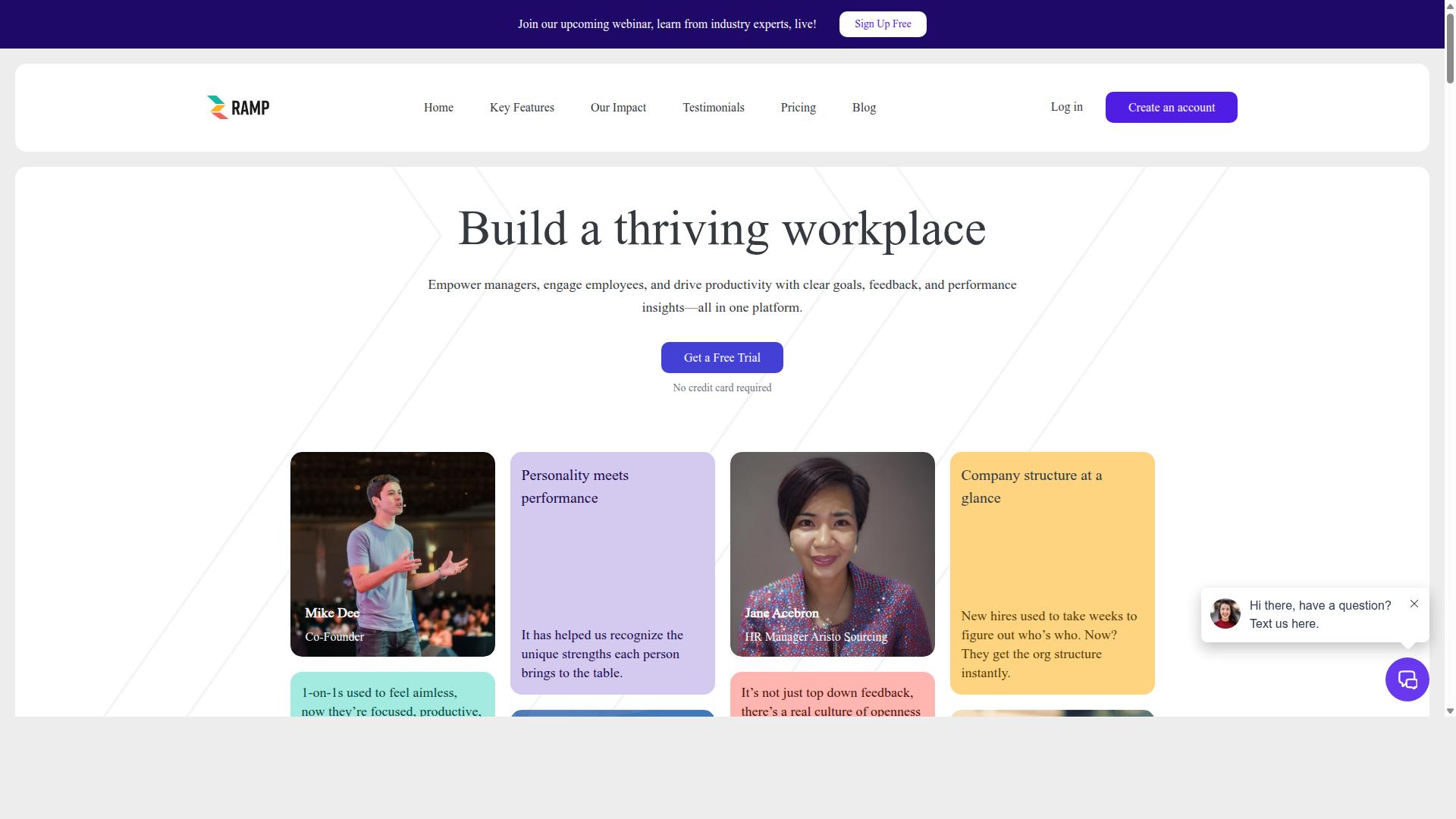
HeyRamp stands out as the best overall 15Five alternative for pulse surveys, combining robust survey capabilities with a comprehensive performance management suite that drives engagement and productivity. Unlike survey-only tools, HeyRamp connects every pulse check to a broader system of employee development, so feedback never sits in a vacuum.
The platform includes guided conversation templates, sentiment prompts, and automated reminders that make running pulse surveys simple. These features help managers stay consistent with check-ins while keeping employees engaged between formal review cycles. Real-time feedback flows naturally into 1-on-1 meetings and performance reviews, creating a continuous feedback loop that supports both employee morale and team performance.
Anonymity options and seamless integrations are central to the pulse survey experience. Teams can choose anonymous responses when sensitive topics come up, which encourages honest employee feedback and improves response rates. HeyRamp also integrates with Slack and Microsoft Teams, so employees can complete quick pulse checks without leaving their daily workflow. That convenience matters for engagement surveys, where friction directly reduces participation.
Beyond surveys, HeyRamp is an all-in-one engagement platform with tools for company structure visualization, OKR and goal management, personality insights, and KPI snapshots. It also includes built-in training videos for 1-on-1s, performance reviews, and personality testing, plus automatic compliance documentation with time-stamped secure records. For HR teams, the people analytics dashboards and leadership insights turn raw survey data into clear action planning.
Pricing is straightforward: a flat per-seat fee with a 14-day free trial. There are no surprise per-survey charges or tiered feature gates. HeyRamp serves global teams and is built for organizations that want more than just pulse check software, it targets companies looking to connect employee feedback with goal setting, performance reviews, and ongoing development.
What makes HeyRamp the best overall choice is the value for money and ease of use. It merges survey tools, check-ins, and performance management into one platform, which means managers spend less time switching between systems and more time acting on feedback. That integration of feedback with development is exactly what most 15Five alternatives lack.
2. Workleap
Workleap is a solid alternative for pulse surveys, offering a user-friendly interface and strong engagement analytics, though it may have limitations in advanced performance management features. It is designed primarily for small and medium-sized businesses that want to keep a finger on the pulse of employee sentiment without drowning in administrative work.
The platform comes with customizable survey templates that teams can adapt to their specific needs. Managers can quickly deploy pulse checks to measure morale, workload, and overall satisfaction. The real-time analytics dashboard turns raw responses into clear trends, so leaders can spot shifts in engagement before they become bigger problems.
Workleap also integrates with popular communication tools like Slack and Microsoft Teams. This means employees can complete quick check-ins right where they already collaborate, which tends to boost participation. The integration with Officevibe, Slack, Jira, and Confluence also allows the system to synthesize feedback from multiple sources into intelligent summaries.
Ease of use is a clear strength for Workleap. The interface is clean and intuitive, making it approachable for HR teams that do not have dedicated analytics specialists. Employee sentiment tracking is another highlight, as the platform helps organizations understand not just what employees say, but how they feel over time.
However, there are some potential weaknesses to consider. Workleap may not offer the same depth of performance review tools as more comprehensive platforms. Teams looking for robust goal setting, detailed performance evaluations, or complex compensation planning might find the feature set somewhat limited. Additionally, the cost for advanced features could be higher than what some smaller teams expect, though specific pricing is not publicly detailed on their pages.
Compared to HeyRamp, Workleap is strong for surveys but takes a narrower approach. While Workleap focuses heavily on engagement tracking and feedback loops, HeyRamp offers a more comprehensive solution that covers broader performance management needs. For organizations that want pulse surveys plus deeper tools in one place, the wider scope can make a meaningful difference.
How to Choose the Right Option
Choosing the right 15Five alternative for pulse surveys requires aligning the tool's features with your organization's specific goals, culture, and technical ecosystem. Start by identifying your primary pain point. Are you chasing quick, frequent pulse checks to gauge employee morale, or do you need a full performance management suite with OKR software, performance reviews, and goal setting?
Being honest about your current stage matters. A small team exploring continuous feedback might thrive with a lightweight survey tool, while a larger organization may need workforce analytics, culture analytics, and sentiment analysis built in. Write down your top three engagement challenges before you evaluate any software.
Next, define your must-have features. Consider anonymity for honest manager feedback, mobile app access for frontline workers, and native integrations with Slack or Microsoft Teams. Also think about action planning, survey templates, benchmarking, and whether you need real-time feedback or scheduled pulse check cycles.
Create a shortlist of non-negotiables. If your managers are busy, look for tools that make check-ins and follow-through easy. The right tool should not only collect employee feedback but also enable action and follow-through, otherwise response rates will drop and employee voice becomes noise.
Budget and team size shape the decision. Some platforms use per-seat pricing that scales quickly, while others charge flat fees. Calculate the total cost for your headcount, including any onboarding or training expenses. Scalability and ease of adoption matter just as much as price; a tool that requires heavy training may stall adoption.
Read user reviews and request trials before committing. Test the survey tools with a small pilot group and watch how managers respond to the results. Ask about response rates, sentiment analysis quality, and whether the platform supports continuous feedback loops between managers and employees.
Here is a practical comparison checklist to guide your evaluation:
- Does it support anonymous pulse surveys and engagement surveys?
- Is there a mobile app or is it desktop-only?
- Does it connect with Slack, Microsoft Teams, or your HR software?
- Are action planning and follow-up workflows built in?
- Does it offer benchmarking against industry standards?
- Can it grow from pulse checks to full performance management?
- What is the pricing model and does it fit your team size?
- How steep is the learning curve for managers and HR?
- Does it surface employee morale trends over time?
For organizations that prioritize manager-employee engagement, HeyRamp targets leadership, line managers, human resources, and individual contributors. It is built for teams seeking improved performance management, employee engagement, goal alignment, and team development, which makes it a strong fit when your focus is on strengthening the manager-employee relationship rather than just collecting survey responses.
Finally, remember that pulse surveys are a means, not an end. The best engagement platform turns feedback into visible action. If employees see their input spark change, retention and morale improve. If the tool simply collects data without enabling follow-through, even the most polished survey software will fail to move your culture forward.
Final Verdict
In the final verdict, HeyRamp emerges as the superior 15Five alternative for pulse surveys, offering the best combination of features, value, and ease of use. Pulse surveys matter because they capture employee sentiment in real time, helping leaders spot morale shifts before they become retention problems. The right survey software turns anonymous feedback into actionable insights, and both HeyRamp and Workleap deliver on that core promise.
When comparing the two, HeyRamp stands apart on several fronts. It is trusted by 20+ organizations and 400+ teams, which speaks to its reliability across diverse workplaces. Workleap offers solid engagement tools, but HeyRamp pairs pulse surveys with a broader performance management suite that includes personality insights, aggregated people analytics dashboards, and guided conversation templates for difficult discussions.
Pricing is another decisive factor. HeyRamp uses a one flat fee pricing model, so you never have to guess what your engagement platform will cost as your team grows. Workleap and other 15Five alternatives typically scale their pricing per seat, which can become unpredictable. For HR leaders watching budgets, flat-fee pricing simplifies planning and removes the friction of per-user upgrades.
What truly tips the scale is how HeyRamp supports managers beyond the survey itself. Built-in training and education help leaders act on feedback, while instant coaching tips and automated reminders keep follow-through consistent. The platform also generates automatic compliance documentation, saving HR teams hours of manual record keeping. These features work together to turn pulse check responses into real action, not just data collection.
Employee engagement is not a one-time initiative. It requires continuous feedback, regular check-ins, and a culture where employee voice actually shapes decisions. HeyRamp's all-in-one platform makes it the best overall choice for organizations seeking to improve engagement and performance, because it connects survey results to manager feedback, goal setting, and team performance in one place.
If you are evaluating survey tools to replace 15Five, start with the option that covers the most ground. HeyRamp delivers the pulse survey capabilities you need, plus the performance management infrastructure to act on what you learn. Try HeyRamp's 14-day free trial to experience its pulse survey features firsthand and see how they fit your team's rhythm.